material
Black Onyx: material & care guide

Black chalcedony in trade descriptions
Black onyx in the jewelry trade commonly refers to opaque black chalcedony, a fine-grained quartz material that may be treated for color. GIA describes treated black chalcedony among familiar opaque jewelry materials. Its smooth, even appearance differs from the moving flash of some dark gems. Read the material and treatment description when choosing beads, a cabochon or a carved pendant.
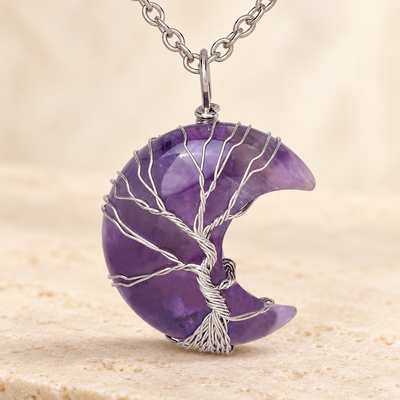
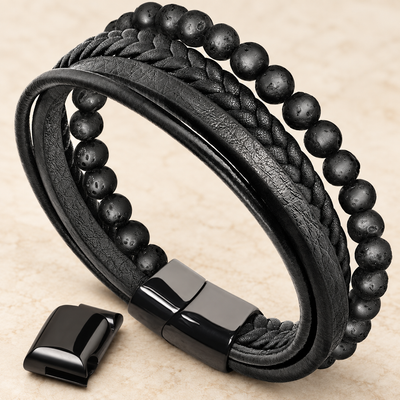
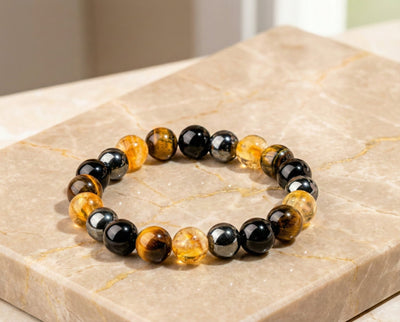
An even black palette leaves shape and finish especially visible. A matte strand can look quite different from a highly polished one even if the bead diameter is the same. Compare the consistency of those surfaces and read the treatment description alongside them. A dark cabochon creates one continuous face, while a carved pendant introduces edges and recesses that change the silhouette. Keeping these construction choices separate from the color makes a more useful comparison than assuming every black strand is the same material or offers the same wearing experience.
Carved jewelry and contemporary steadiness
Onyx and related chalcedony materials have a long place in carved and decorative jewelry. Contemporary crystal traditions associate black onyx with steadiness, focus and Protection. A modern wearer may choose the clean dark palette as a reminder to hold a boundary or stay with a chosen task, adding a personal meaning to an understated material.
One accent within a dark strand
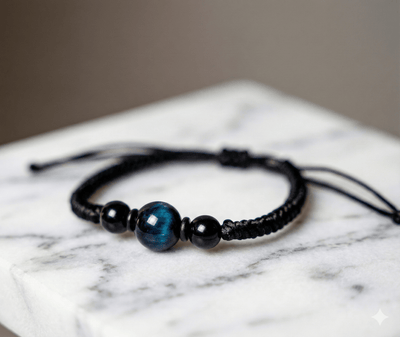
A single black strand is often worn as a simple everyday bracelet, with one accent bead or charm carrying the main message. Some wearers use a pendant at a length that keeps it tucked neatly under a collar. For a desk or reflection space, a polished object can be placed on a soft mat where it is easy to handle carefully.
Matte finish, polish and bead consistency
Compare polish, bead consistency and the stated wrist range rather than choosing by color alone. A matte finish gives a quieter look than a high polish; a bright silver or warm metal accent creates a clear focal point. Check whether an accent is plated or solid metal and compare its diameter with the surrounding beads for comfortable movement.
If one accent is intended to carry the main message, look at how it meets the surrounding black beads. An accent that is much taller can change the bracelet's outline and its contact beside a watch. A smaller bright metal detail may create contrast without dominating the strand. Check whether that metal is described as solid or plated so the finish remains part of the comparison. For a focus reminder, the clean dark palette can stay deliberately simple. A necklace tucked near a collar may favor a contained shape, whereas a visible carving can make the chosen symbol more prominent.
Disclosed color treatment and clasp contact
Follow any disclosed color-treatment care, keeping the piece away from strong heat and harsh solvents.
Measuring help: the size hub. Care methods: the care guide.
The focus intention and metal contrast are developed in the success focus intention guide and sterling silver material notes. For an accent's dimensions or the color-treatment description, contact Lab.
Cultural and material background: GIA: identifying black opaque gem materials.