symbol
Om Mani Padme Hum: meaning & wearing guide

Inscription or rotating object
Om Mani Padme Hum is a six-syllable mantra associated with Avalokiteshvara, the bodhisattva of compassion, in Tibetan Buddhist practice. It may appear in inscriptions, prayer wheels and prayer-bead accessories. A decorative script panel and a functional prayer wheel are different objects: look at the lettering, construction and intended use rather than relying on a small thumbnail alone.
The words and the object carrying them deserve separate attention. A flat inscribed accent can be worn as a pendant; a prayer wheel introduces an axle, a turning section and a different way of handling the piece. Decide whether you are looking for a readable reminder or an object for a practice learned within your community. A decorative wheel-shaped charm may emphasize the silhouette without serving the same practical purpose as a described working wheel. Clear photographs of the inscription and the mechanism help you compare those choices before considering the metal color.
Compassion and wisdom in context
The Met describes the mantra through the union of compassion and wisdom represented by Avalokiteshvara. This context gives the inscription its religious meaning. Contemporary jewelry wearers may use it as a reminder of compassionate speech and mindful attention; a practitioner may relate the same words to recitation within a particular teaching lineage.
Learning recitation and respectful handling
In Tibetan Buddhist practice, recitation and prayer-wheel use are learned within a community, with attention to intention and respectful handling. A wearer can keep an inscribed pendant upright and readable, or choose a bead that is comfortable to touch during a personal pause. For devotional practice, follow instruction from your teacher about recitation, bead handling and the turning of a prayer wheel.
A readable panel and secure mechanism
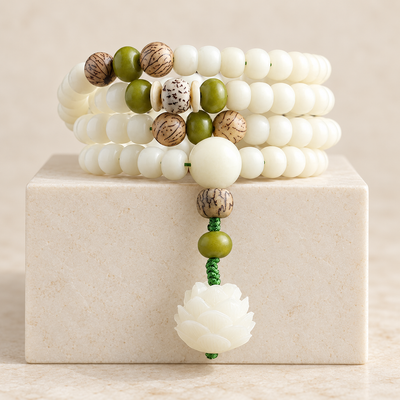
Inspect a clear photograph of the actual inscription, including both sides if the piece is reversible. Compare the panel's height, the bail opening and the cord or chain length. Wood beads give a light, tactile arrangement; metal accents can make the lettering easier to read. For a rotating object, check that its moving parts are described and securely attached.
For a small pendant, follow the inscription across the actual surface instead of relying on a distant image of the entire necklace. Raised edges, a curved panel and lettering on both sides can affect how it sits against clothing. For a rotating object, look at the support and attachment as carefully as the turning section; neither should disappear behind decorative detail in the photograph. A simple wood-bead arrangement can keep attention on the inscribed accent. If recitation is your aim, let your teacher's guidance determine the appropriate form rather than selecting a mechanism solely for its appearance.
Grooves, paint and moving parts
Wipe inscribed grooves with a soft cloth or a dry brush suitable for the stated material. Keep polishing compounds away from painted lettering and plated surfaces. Avoid pulling on a prayer wheel's moving section or forcing a stiff spindle. Store an inscribed piece where a chain will not scratch its lettering or twist around a moving attachment.
Measuring help: the size hub. Care methods: the care guide.
The practice-oriented intention and sandalwood pairing are explored in the spiritual growth intention guide and sandalwood material notes. For an inscription view or mechanism description, contact Lab.
Cultural and material background: The Met: six-syllable Avalokiteshvara.